Giovanni Bongiovanni
Tintura Madre
curated by Isabella Vitale
1/9unosunove is pleased to announce Tintura Madre, the first solo exhibition by Giovanni Bongiovanni (Augusta, 2001) in the historic spaces of Palazzo Santacroce, curated by Isabella Vitale.
The project follows an exhibition programme that, over the past two years, has seen Bongiovanni take part in a series of major art fairs alongside 1/9unosunove, in Rome, Verona, and Bologna. This sustained presence has progressively drawn the attention of curators, collectors, and professionals within the art world, helping to define the profile of one of the most promising voices in new Italian painting.
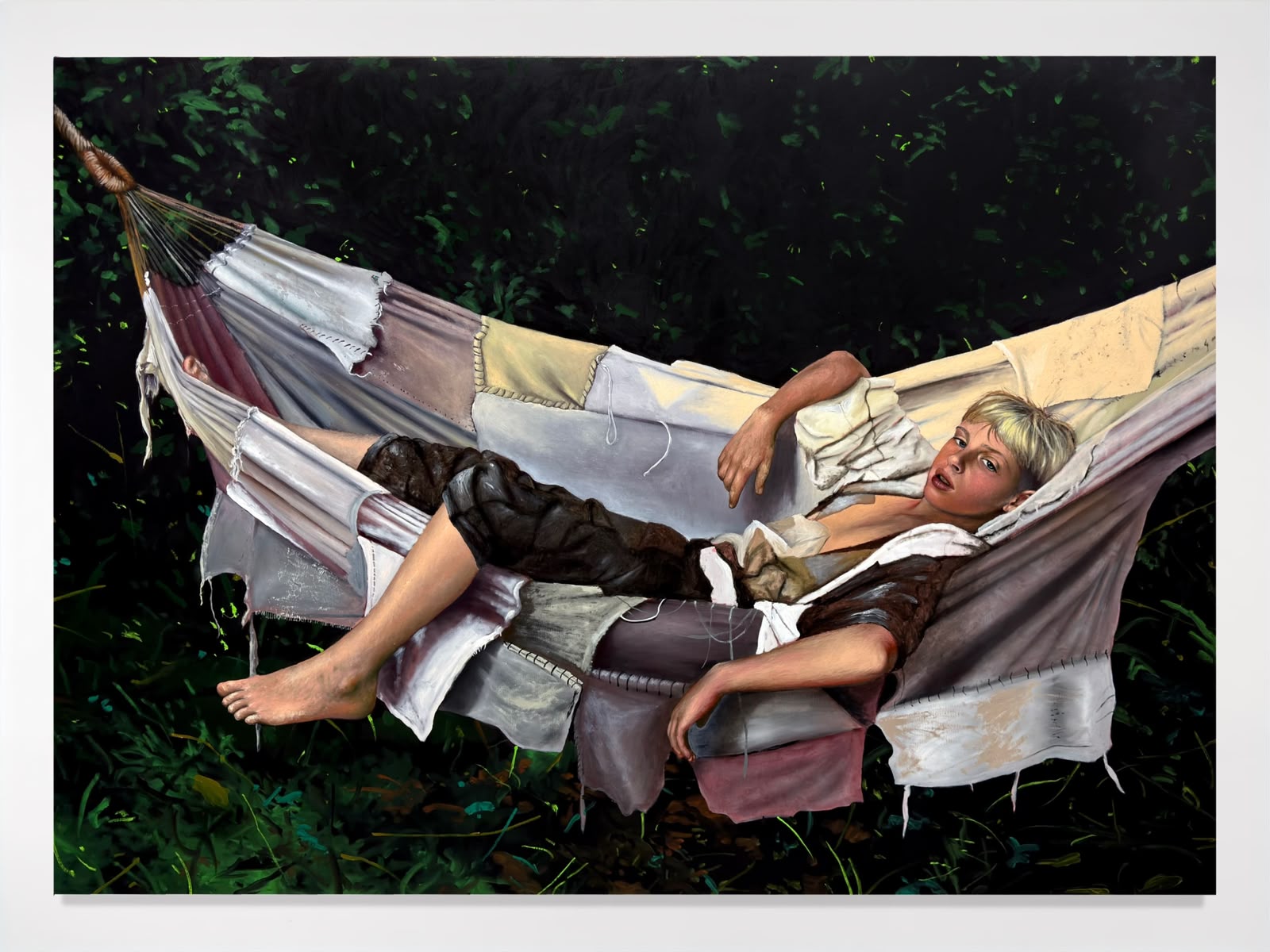
Tintura Madre brings together a previously unseen body of works produced in 2026 and offers, for the first time, a comprehensive encounter with the artist’s most recent research. The title provides the key to entering his painting: a mother tincture is produced by extracting leaves, flowers, and herbs gathered during their balsamic period, when they reach their highest degree of vitality. It is at this same threshold, between growth and transformation, that Bongiovanni places his figures: young subjects suspended in an age that is still uncertain, before their world becomes defined by the categories and conventions of adulthood. Immersed in a lush yet unsettling natural environment, the protagonists of his works occupy an ambiguous position. They are alternately victims and perpetrators, actors and spectators, observed and observers. They catch the gaze of those on the other side of the canvas as though they have been unexpectedly discovered in the midst of a ritual or a private scene. And yet they do not withdraw: they return that gaze with pride, assuming an almost theatrical presence. Light isolates them and draws them out from the dark depths of the vegetation, while the surrounding environment seems at once to protect, restrain, and threaten them.
It is precisely in the tension between belonging and estrangement, familiarity and disturbance, that Bongiovanni’s painting finds one of its most distinctive characteristics. His figures inhabit a remote and undefined future, as though suspended midway through an evolutionary process that has yet to unfold. Clothing, ornaments, architecture, and objects emerge from the combination of heterogeneous materials and references: plastics and skins, grasses and rubber tubes, strings of pearls and imaginary fruits coexist within a logic of assemblage that eludes the hierarchies of the known world.
Space itself follows the same rule. Bongiovanni’s settings appear to be ritual sites where the sacred and the profane overlap, where fragmented objects are recomposed into totems and sculptures whose function remains indecipherable. Domestic animals and wild beasts share the same territory; natural elements and manufactured objects contaminate one another; what belongs to reality and what seems to have emerged from an invented world coexist seamlessly. What emerges is a painting built on contamination: a universe in which every element seems to belong to a different order while, at the same time, unexpectedly finding its own place. Nature is not merely a backdrop, but an active force that envelops bodies, conceals them, and exposes them; the body itself becomes a surface of transformation, a place where materials, identities, and forms can be continuously recombined.
All the works in Tintura Madre were produced in 2026 in the artist’s studio, immersed in the Sicilian countryside, a landscape that has for years constituted an essential source for his practice.At the conclusion of the exhibition project, Giovanni Bongiovanni will also undertake a period of residency at pianobi, the residency space founded by Isabella Vitale in Rome’s Quadraro Vecchio neighbourhood.